June 2026: Stepscale selected for DMZ's Centre for Housing Innovation Accelerator... Read more →

RFP content library for AEC firms

Make your firm’s best proposal content easy to find and reuse.

Turn past proposals, project experience, resumes, standards, and supporting documents into searchable firm knowledge connected to the RFP your team is working on now.

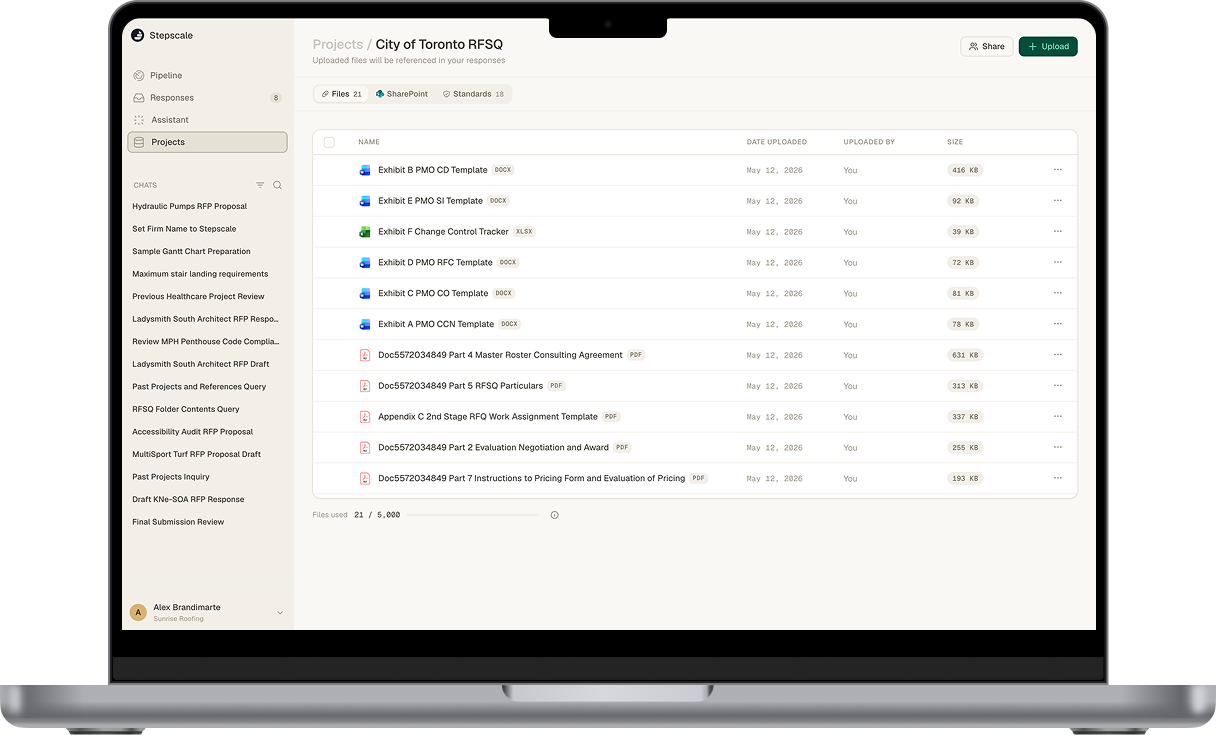
Stepscale document library containing project files for an AEC pursuit

Firm knowledge in the response workflow

What engineering proposal teams say about using firm knowledge in Stepscale

“It helps us work through complex engineering RFPs, organize the requirements, and get a solid first draft of the technical response, resumes, project experience, fees and schedule.”

Randall Trites, P.L.(Eng.) · ROHI Engineering

The answer exists somewhere

Stop rebuilding knowledge the firm already paid to create.

The strongest reference may be buried in an old proposal. The right resume may be out of date. A technical answer may live in a project folder only one person remembers. The problem is not a lack of expertise—it is finding the right evidence in time to use it.

Scattered proposal knowledge

  • Search shared drives one folder at a time.
  • Reuse the easiest example instead of the strongest one.
  • Ask technical staff to recreate previous answers.
  • Copy old language without its original context.

Searchable firm knowledge

  • Search across relevant project and proposal material.
  • Match past work to the current opportunity.
  • Bring source-backed content into the first draft.
  • Keep experts focused on accuracy and differentiation.

From archive to active pursuit

Put past work where proposal teams can use it.

01

Bring the firm’s working knowledge together.

Use past proposals, project sheets, resumes, meeting notes, standards, and supporting files already created through real work. Stepscale makes their contents usable inside the RFP workflow.

Name Date uploaded
RFSQ — Municipal engineering services.pdf
Apr 15, 2026
Past performance — transit program.pdf
Mar 27, 2026
SharePoint link — safety stats
Dec 1, 2025
Workflows by phase.csv
Dec 1, 2025
Stepscale / Reference Matching
5 matches found
New RFP
Edmonton LRT Extension – Structural Engineering
City of Edmonton · $8.5M · Structural, Geotech, Transit
Transit Structural $5M+ Geotechnical Municipal
Past Projects — Ranked by Relevance
Calgary Green Line – Bridge Structures
94%
City of Calgary · $7.8M · Completed 2025
Transit ✓ Structural ✓ $5M+ ✓ Municipal ✓
02

Find evidence that fits this RFP.

Compare the opportunity with the firm’s sectors, services, geography, client type, scope, and delivery experience. Surface the references that best demonstrate the team can do the work.

03

Draft from source material your team can review.

Use relevant firm knowledge to prepare a stronger starting point. Proposal coordinators and technical experts confirm the claims, improve the approach, and approve the final wording.

Sections & narrative

Cover through pricing—expand to edit

Cover & transmittal
Approved
Executive summary
Approved
Technical approach
Review
Past performance
Review
Pricing & basis of estimate
Review

More than an answer bank

Organize the proof behind the proposal.

Project experience

Find comparable work by scope, sector, geography, client, services, and delivery experience.

People and qualifications

Bring resumes, roles, credentials, and relevant team experience into the response context.

Methods and supporting knowledge

Reuse approved approaches, standards, codes, lessons, and proposal language with their sources available.

See how the same knowledge supports RFP evaluation and response drafting.

RFP content library FAQ

Questions about reusing firm knowledge.

How Stepscale helps teams find and use past work without replacing the judgment behind it.

What is an RFP content library?

An RFP content library organizes reusable proposal knowledge such as past responses, project experience, resumes, methods, certifications, and supporting documents so teams can find and adapt the right material for a new pursuit.

How is an RFP content library different from a shared drive?

A shared drive stores files. An RFP content library makes the information inside those files searchable and connects relevant material to the requirements and context of the current opportunity.

Can Stepscale use past proposals, project sheets, and resumes?

Yes. Stepscale can make past proposals, project sheets, resumes, and related firm documents searchable, then surface relevant source material for reference selection and response drafting.

Does Stepscale replace our document-management system?

Not necessarily. Stepscale is designed to support the RFP workflow and can work with firm knowledge that already exists in your document environment. Your team can keep the systems that remain useful for records and file management.

How does Stepscale choose relevant past projects for an RFP?

Stepscale compares the new opportunity with available project context such as sector, scope, services, geography, client type, and delivery experience. It shows relevant references for the team to validate rather than relying only on the newest project.

Can the library support first-draft preparation?

Yes. Relevant firm knowledge can be used to support a first draft grounded in the firm's actual experience. Proposal and technical teams still review the source, accuracy, positioning, and final wording.

Is our proposal content used to train AI models?

No. Stepscale's privacy policy states that customer data is not used to train or improve Stepscale's AI models, and that third-party model providers do not use submitted information to train their models.

Read our privacy policyVisit the Trust Centre

Where to from here

Put Stepscale to work on a real RFP.

Share a recent opportunity and see how Stepscale organizes the requirements, finds relevant past work, builds a first draft, and checks the response before submission.

  1. 01

    Your RFP, not a canned demo

    Walk through a real, recent opportunity.

  2. 02

    Your firm knowledge in context

    Use your projects, resumes, and past proposals.

  3. 03

    The complete response workflow

    From requirements to first draft and final review.