RFP response software for AEC firms

RFP response software built around your firm’s best work.

Turn complex architecture, engineering, and construction RFPs into organized, reviewable responses. Stepscale connects the solicitation, requirements, past project knowledge, first draft, and final compliance pass in one workspace.

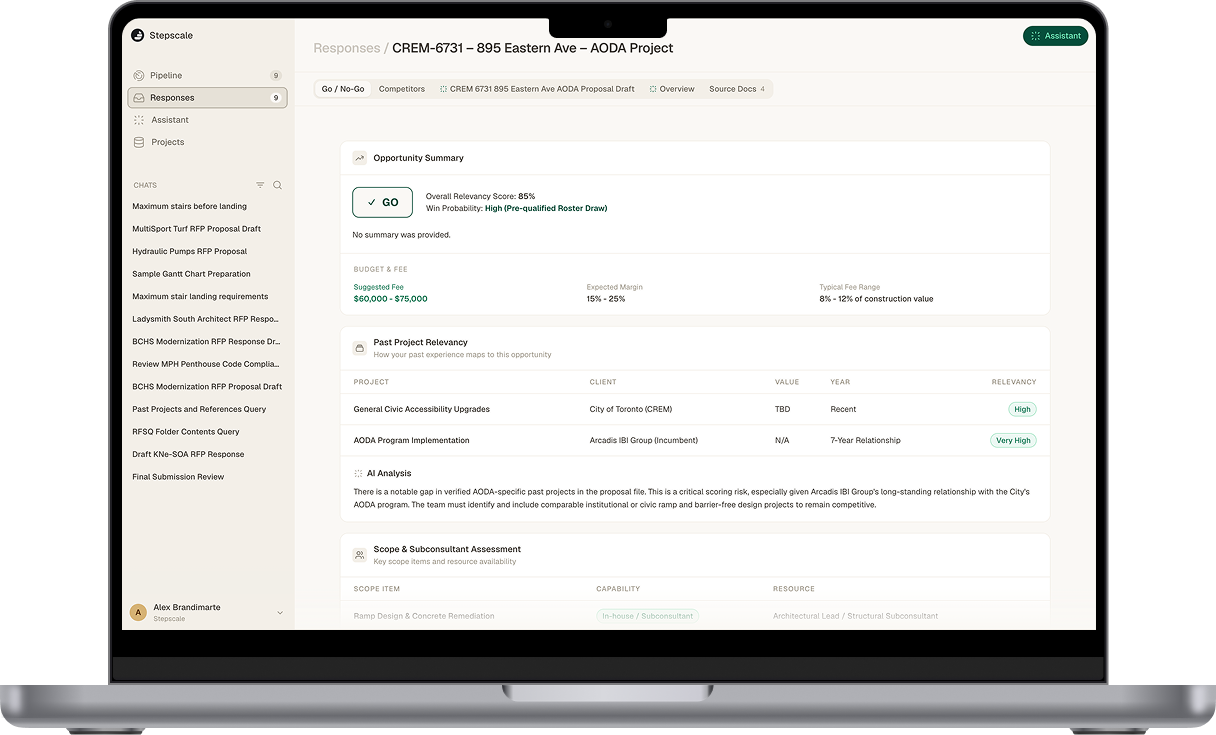
Stepscale workspace showing an AEC proposal response

Used in real engineering pursuits

What AEC proposal teams say about Stepscale

“Stepscale has made proposal preparation at ROHI more efficient. It helps us work through complex engineering RFPs, organize the requirements, and get a solid first draft of the technical response, resumes, project experience, fees and schedule.”

Randall Trites, P.L.(Eng.) · ROHI Engineering

One response, too many places

Stop rebuilding the proposal process for every pursuit.

The RFP is in a portal. Addenda arrive later. Past projects live in shared drives. Resumes go stale. Technical input travels through email, and the final review starts against the deadline. Stepscale gives proposal coordinators, technical contributors, and firm principals one connected response workflow.

Without a connected workflow

  • Requirements are copied into separate trackers.
  • Teams hunt through old folders for usable proof.
  • First drafts repeat work the firm has already done.
  • Mandatory items are checked late in the process.

With Stepscale

  • Keep the solicitation and extracted requirements together.
  • Find relevant projects, resumes, and past response language.
  • Build a grounded first draft for expert review.
  • Run a final pass against the RFP before submission.

From source document to submission

A practical RFP response workflow for AEC teams.

Each stage carries the context from the one before it, so your team spends less time transferring information and more time shaping a response that is accurate, specific, and defensible.

01

Organize the ask before anyone starts writing.

Bring the source documents, dates, requirements, and evaluation context into one opportunity. Proposal coordinators can give the team a usable brief without manually reconstructing the RFP.

Opportunity snapshot

Municipal bridge rehabilitation — RFP

Rehabilitation design and contract administration for three municipal bridges.

Details

Key metadata

Client Regional municipality
Due Mar 28, 2026 — 2:00 p.m. ET
Type RFP — full & open

Schedule & milestones

Typical solicitation path to award

RFP issued Jan 15
Q&A due Feb 3
Amend. Feb 18
Proposals due Mar 28
Eval. / BAFO Apr–May
Award TBD

Requirements

3

Bridge assessment and rehabilitation methodology.

Approach

Project manager and key personnel qualifications.

Team

Three comparable bridge rehabilitation projects.

Experience
Stepscale / Reference Matching
5 matches found
New RFP
Edmonton LRT Extension – Structural Engineering
City of Edmonton · $8.5M · Structural, Geotech, Transit
Transit Structural $5M+ Geotechnical Municipal
Past Projects — Ranked by Relevance
Calgary Green Line – Bridge Structures
94%
City of Calgary · $7.8M · Completed 2025
Transit ✓ Structural ✓ $5M+ ✓ Municipal ✓
02

Start with the experience that actually fits.

Search your firm’s project sheets, resumes, previous proposals, and supporting material. Surface the most relevant experience for this pursuit instead of defaulting to the easiest file to find.

03

Build the first draft from firm knowledge.

Develop sections around the RFP’s structure and your real past work. Technical experts still own the approach and accuracy; Stepscale removes repetitive blank-page work and makes their review more focused.

Sections & narrative

Cover through pricing—expand to edit

Cover & transmittal
Approved
Executive summary
Approved
Technical approach
Review
Past performance
Review
Pricing & basis of estimate
Review

Review complete

Scanned 2 files

PDF

Solicitation_RFP_2026.pdf

No findings

View

Draft the executive summary using our win themes and the scored requirements.

Here is a concise executive summary aligned to the RFP priorities and your past performance highlights.

The response ties scope to evaluation criteria and cites your project knowledge where the solicitation allows.

RFP Section C Past performance.pdf

Tighten Section 4.2 against the evaluation matrix and call out the differentiators we use in Pipeline.

Section 4.2 now mirrors criteria C1–C4 in order, with one paragraph each on delivery model, QA, safety record, and staffing continuity. Differentiators reference the same proof points as your Pipeline opportunity card.

Add a short risk paragraph for supply chain and cite the mitigation we used on the LRT phase 2 pursuit.

Draft language ties subcontractor exposure to the LRT phase 2 mitigation narrative (dual sourcing, inspection hold points) and keeps it within the page limit.

LRT phase 2 — risk memo.pdf
Describe your task or simply add a file to review
04

Review the response against the RFP.

Check the working submission for missing or incomplete requirements while there is still time to act. Your team confirms the technical content, mandatory forms, approvals, and final package.

Built for how AEC firms respond

Bring technical experts in where their judgment matters.

Proposal coordinators need control over requirements, assignments, versions, and deadlines. Principals need to make decisions and protect non-billable time. Technical contributors need enough context to improve the approach without searching for the latest file.

Stepscale supports those roles in one pursuit workspace. It handles more of the repetitive preparation while your team owns the differentiators that make an architecture, engineering, or construction response credible.

RFP response software FAQ

Questions from proposal teams.

Straight answers about how Stepscale fits into an AEC response workflow.

What is RFP response software?

RFP response software helps proposal teams turn a solicitation into a managed response. It organizes requirements, brings relevant firm knowledge into the draft, coordinates review, and checks the submission for gaps before it is delivered.

How is RFP response software different from proposal management software?

The terms often overlap. Proposal management software commonly focuses on coordinating the response after a firm decides to bid. Stepscale connects that response work to the live solicitation, opportunity evaluation, past project knowledge, and pre-submission review.

Can Stepscale draft from past proposals, project sheets, and resumes?

Yes. Stepscale makes past proposals, project sheets, resumes, and other firm knowledge searchable, then uses relevant source material to support the first draft. Your team reviews and approves the response before submission.

Does Stepscale support RFPs, RFQs, SOQs, and tenders?

Yes. Stepscale supports response workflows for RFPs, RFQs, SOQs, RFSOs, EOIs, RFIs, IFBs, and tenders. The terminology and deliverables vary, but the same workspace can keep the source documents, requirements, firm knowledge, and working response together.

Can proposal coordinators and technical contributors work from the same response?

Yes. Proposal coordinators can organize the pursuit and response while principals and technical contributors add judgment, validate claims, and review the sections they own. That keeps the response context in one place instead of scattering it across email and file versions.

Does Stepscale replace proposal coordinators or subject-matter experts?

No. Stepscale reduces repetitive work such as requirement extraction, content search, first-draft preparation, and compliance checks. Proposal coordinators, principals, and subject-matter experts still own strategy, technical accuracy, approvals, and the final submission.

How does Stepscale review an RFP response for compliance?

Stepscale compares the working response with the solicitation's requirements and flags missing or incomplete items for the team to review. It supports the final quality-control pass; your team remains responsible for confirming every mandatory requirement before submission.

Is our proposal data used to train AI models?

No. Stepscale's privacy policy states that customer data is not used to train or improve Stepscale's AI models, and that third-party model providers do not use submitted information to train their models.

Read our privacy policy Visit the Trust Centre

Where to from here

Put Stepscale to work on a real RFP.

Share a recent opportunity and see how Stepscale organizes the requirements, finds relevant past work, builds a first draft, and checks the response before submission.

  1. 01

    Your RFP, not a canned demo

    Walk through a real, recent opportunity.

  2. 02

    Your firm knowledge in context

    Use your projects, resumes, and past proposals.

  3. 03

    The complete response workflow

    From requirements to first draft and final review.